
Traditional Dental Crowns vs CEREC Crowns – Which Is Better?
When your dentist recommends a dental crown, you usually don’t get one option anymore.
Today, you have a choice:
Traditional crown or CEREC same-day crown?
Most patients don’t understand the difference—and end up choosing based on price or convenience, which is a mistake.
This blog breaks down the real difference between traditional crowns and CEREC crowns, so you can choose what actually lasts longer and performs better.
What Is a Traditional Dental Crown?
A traditional crown is made using:
- Physical impressions (molds)
- External dental lab fabrication
- Temporary crown placement
Process:
- Tooth preparation
- Impression taken
- Temporary crown placed
- Lab makes final crown (5–10 days)
- Second visit for final fitting
What Is a CEREC Crown?
A CEREC crown is a digitally designed and manufactured ceramic crown, made and placed in a single visit using CAD-CAM technology.
Process:
- Digital scan (no impression)
- Computer-based design
- In-clinic milling
- Same-day permanent crown placement
Total time: 60–90 minutes.
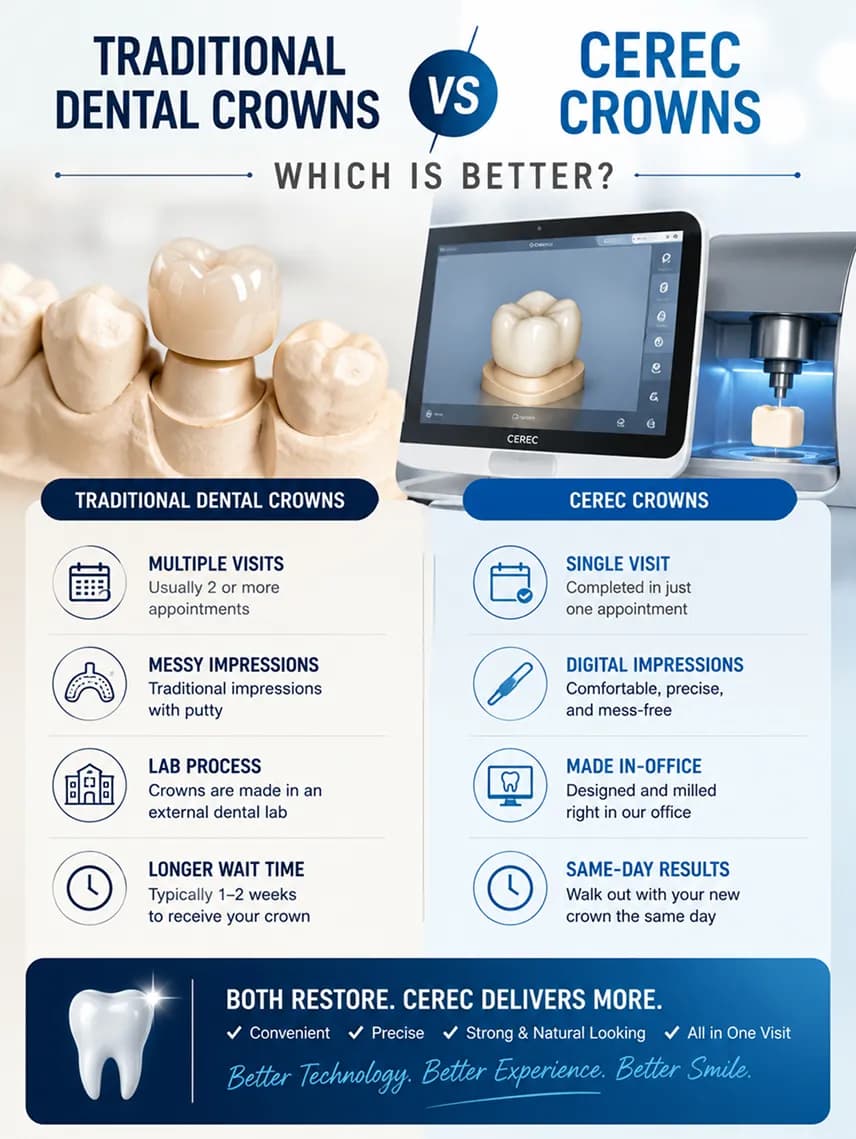
Traditional Crowns vs CEREC Crowns – Key Comparison
1. Time Required
- Traditional: 2–3 visits, 1–2 weeks
- CEREC: Single visit, same-day crown
2. Accuracy & Fit
- Traditional: Depends on impression + lab work
- CEREC: Digital precision with micron-level accuracy
3. Comfort
- Traditional: Messy impressions, temporary crown discomfort
- CEREC: No impressions, no temporary crown
4. Strength & Material
- Traditional: Metal-ceramic or lab-made crowns
- CEREC: High-quality ceramic blocks with uniform strength
5. Risk of Error
- Traditional: Higher (manual steps involved)
- CEREC: Lower (digital workflow)
6. Aesthetic Result
- Traditional: Good
- CEREC: More natural, better translucency
Hidden Problem with Traditional Crowns
Most patients don’t realize this:
Temporary crowns can:
- Break or loosen
- Allow bacterial leakage
- Cause sensitivity
- Lead to poor final fit
CEREC eliminates this entire risk because the final crown is placed immediately.
When Is a Traditional Crown Still Used?
Despite advantages of CEREC, traditional crowns may be used when:
- Multiple teeth need complex restorations
- Special lab customization is required
- Case demands layered ceramic work
But for most single crowns, CEREC is faster and more efficient.
Who Should Choose CEREC Crowns?
CEREC crowns are ideal if you:
- Want treatment in one visit
- Have a busy schedule
- Want precise and aesthetic results
- Need a crown after root canal
- Want to avoid temporary crowns
Cost Comparison
- Traditional Crown: Lower initial cost
- CEREC Crown: Slightly higher cost
But here’s the reality:
CEREC offers:
- Fewer visits
- Better fit
- Lower long-term issues
So overall value is often higher.
Final Verdict
If your priority is:
- Speed
- Accuracy
- Comfort
- Long-term reliability
👉 CEREC crowns are the better choice
If your case is complex or budget is very limited:
👉 Traditional crowns may still be used
The Real Difference
This isn’t just about crowns.
It’s about:
- Manual dentistry vs digital dentistry
- Approximation vs precision
- Delayed treatment vs instant results
Conclusion
CEREC technology is not just an upgrade—it’s a shift in how dentistry is performed.
Patients today don’t want:
- Multiple visits
- Temporary solutions
- Delays
They want fast, precise, and long-lasting treatment.
And that’s exactly what digital dentistry delivers.